Stocks Go Up, Stocks Go Down: A Vol Trader's Reality Check
The Truman Show Was Just Practice
Back in 1998, I was a high school kid watching Seinfeld reruns and dragging my friends to see The Truman Show. Jim Carrey's character lived in a fabricated reality where every moment was scripted, every person was an actor, and the whole world revolved around entertaining an audience he never knew existed.
I walked out of that theater completely confused. What was the point? Why did everyone think it was so profound?
Fast forward to today, as an adult who stares at charts every single day, I view the movie completely differently. Maybe we are all in a simulation together, because so many things look eerily similar. Take the dot-com bubble run-up compared to today's AI bubble run-up. Different technology, same human psychology, same chart patterns. It's like we're all following the same script, playing the same roles, just with different props.
The Beautiful Brutality of Market Reality
SPX: The Steady Climb to Nowhere
Take a look at the SPX chart from 1996 to 2001. The market climbed relentlessly, painting a picture of endless prosperity. Investors believed in the new economy, the internet revolution, and the idea that valuations didn't matter anymore. The SPX peaked at 1527.46 in March 2000.
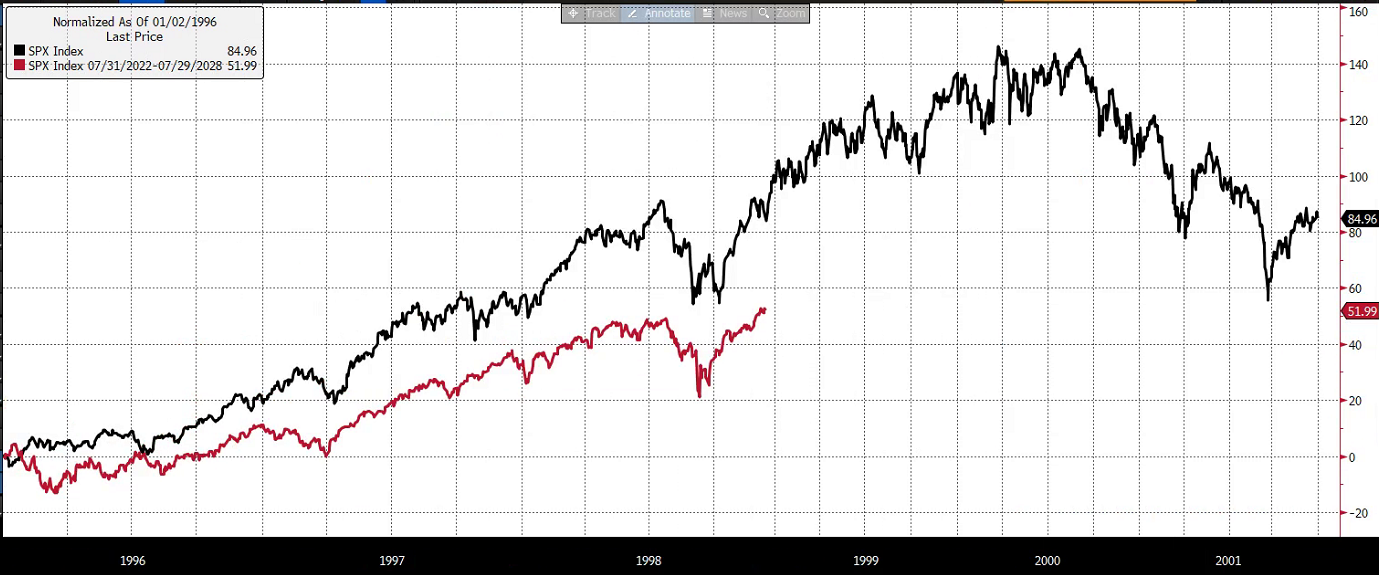
Then reality hit. The index crashed all the way down to 776.76 by October 2002 – a brutal 49% decline that wiped out trillions in market cap faster than you could say "dot-com bubble." But here's the thing that nobody talks about: if you just held on and kept buying, you eventually made money. Because stocks go up over time. It's literally the only trade that works consistently.
Stocks went up. Stocks went down. Then they went up again. Groundbreaking stuff.
VIX: The Fear Gauge That Teaches Us Everything
The VIX tells an even more instructive story. Throughout most of 1996-1997, volatility stayed relatively subdued, hovering around 15-20. Markets were calm, investors were complacent, and vol traders were probably wondering if they'd chosen the wrong profession.
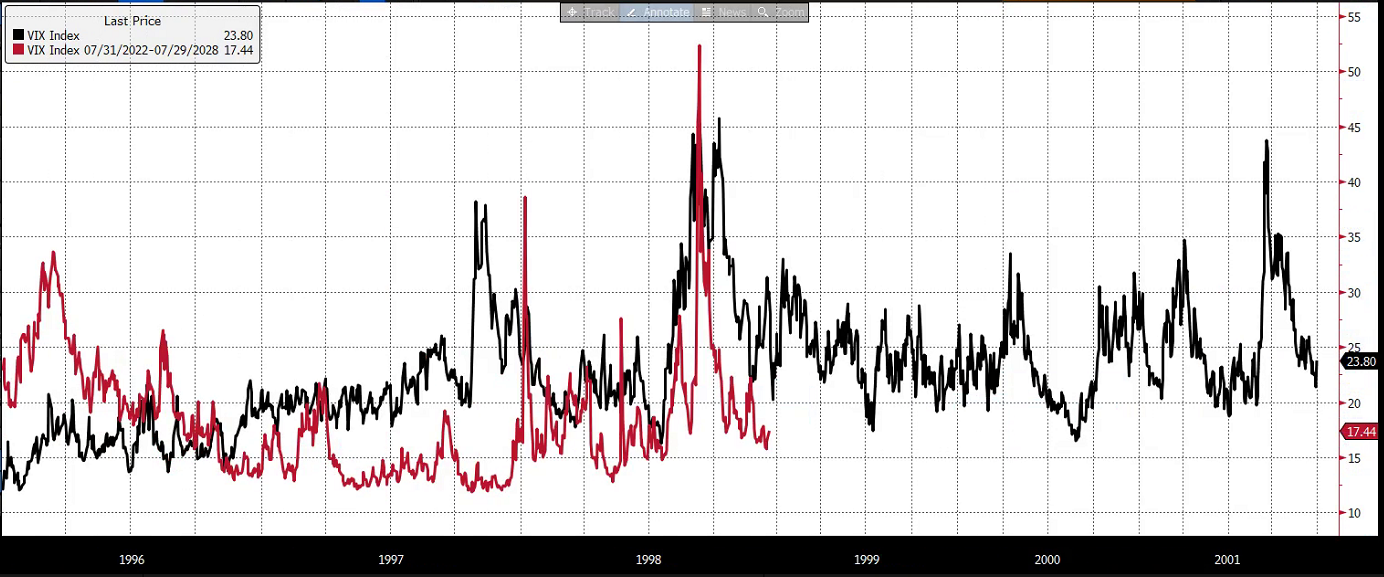
Then 1998 happened. The VIX popped in a big way with the LTCM collapse, spiking over 50 as panic spread through the markets. A lot of people decided to sell stocks that day, thinking the world was ending. But again, that was the wrong approach.
On that day, the best move was to sell vol and use the proceeds to buy back stocks which were now lower. While everyone else was panicking and selling everything, the smart money was selling fear itself and buying assets on the cheap.
This happens again and again. Every crisis, every panic, every "this time is different" moment. The pattern never changes. And this approach - selling volatility while buying stocks during panics - paired with buy and hold, is the best way to invest. Period.
The Simulation Theory of Portfolio Management
We're All Just NPCs in Someone Else's Game
Sometimes I wonder if we're all just characters in some cosmic portfolio management video game. The rules are simple:
- Stocks go up
- Stocks go down
- Volatility spikes when people panic
- Volatility crashes when people get greedy
- Rinse and repeat
The SPX and VIX charts from this period prove my point perfectly. Every spike, every crash, every recovery follows the same basic pattern. It's like the market is running on some fundamental algorithm that nobody bothered to tell us about.
The Only Strategy That Works (And the One That Actually Works)
Here's what 25 years of volatility trading has taught me: There's only one trade that consistently works for stocks - buy and hold. Period. End of story.
I know, I know. You want something more sophisticated. You want day trading strategies and complex derivatives and algorithmic systems. But the SPX chart doesn't lie. From 1996 to today, the only winning move has been to buy stocks and hold them forever.
But here's where it gets interesting. The VIX? That's a different animal entirely. The only trade that works with VIX is the simplest one: buy low, sell high. Those spikes to 50+ during 1998 and 2001? Pure gold if you were smart enough to sell volatility when everyone was panicking.
The Secret Sauce: An Active Approach
Here's where things get interesting. The magic isn't in being passive – it's in being actively intelligent about both sides of the trade.
Hint hint, wink wink - you might need a professional to help you with this one. Someone who's been trading volatility since Seinfeld was still making new episodes.
The secret sauce isn't just buying stocks and holding them forever, or selling VIX above 40 and walking away. It's actively managing the combination: buying stocks lower while selling volatility high, then selling stocks higher while buying volatility back low. The active approach is what makes the magic happen.
When the VIX spikes to 50+ and stocks crash, you're not just mechanically buying stocks – you're actively scaling in while simultaneously covering short vol positions. When volatility is low and stocks are expensive, you're not just holding – you're actively lightening up on both.
It's elegant. It's simple. And it requires constant attention to work properly.
The Eternal Return of Market Cycles
Why 1998 Keeps Happening
The data shows us something profound: markets are cyclical, predictable, and completely unpredictable all at the same time. The SPX chart reveals a classic boom-bust-recovery pattern that we've seen countless times since.
The VIX chart shows us that fear and greed operate on their own timeline, independent of actual market fundamentals. Volatility doesn't care about your DCF models or your technical analysis. It cares about human psychology, and humans haven't changed much since 1998.
The Volatility Trader's Real Advantage
While everyone else argues about whether we're in a bull or bear market, we focus on the only things that actually matter: stocks go up over time, and volatility is mean-reverting.
Those beautiful VIX spikes to 50+? They're not just features of the system – they're opportunities. Every period of low volatility sets up the next volatility explosion. Every panic creates the conditions for the next period of complacency.
Look, it doesn't take a rocket scientist to know you should sell VIX when it tops 40. Anyone can look at the chart and see those spikes always come back down. The problem isn't identifying the opportunities – it's holding the positions long enough to profit without the carrying costs bleeding you dry.
That's where the professionals come in. The real expertise isn't in the entry – it's in structuring positions that you can actually hold for the long term without losing an arm and a leg to time decay and roll costs.
The real money isn't in predicting direction – it's in actively managing the volatility risk premium while riding the long-term equity trend. Anyone can see VIX at 50 and think "sell." The pros know how to structure that trade so they can actually hold it without getting crushed by the costs.
When you combine buy-and-hold equity exposure with an active volatility trading approach, magic happens. But emphasis on active – this isn't a set-it-and-forget-it strategy.
Welcome to the Machine
The Matrix Has You
Maybe Truman was onto something. Maybe we're all trapped in someone else's show, where the only script is "stocks go up, stocks go down." But unlike Truman, we can't escape to the real world – this is the real world.
The SPX climbed, crashed, and recovered. The VIX spiked, crashed, and spiked again. And somewhere in between, portfolio managers like us figured out how to extract alpha from the chaos.
The Only Truth That Matters
At the end of the day, after all the analysis, all the models, all the sophisticated strategies, we're left with two immutable truths: stocks go up over time, and volatility is mean-reverting.
Buy and hold works for stocks. Buy low, sell high works for VIX. Put them together with proper timing and professional expertise, and you've got something special.
The sooner you accept that we're all just players in this grand simulation, the sooner you can start profiting from the game's actual rules instead of trying to invent new ones.
Welcome to the Truman Show of portfolio management. The cameras are rolling, the audience is watching, and the only certainties are that stocks trend up and volatility reverts to mean.
Now, can someone please tell me where I can find a professional to help me execute this strategy properly? Wink wink